
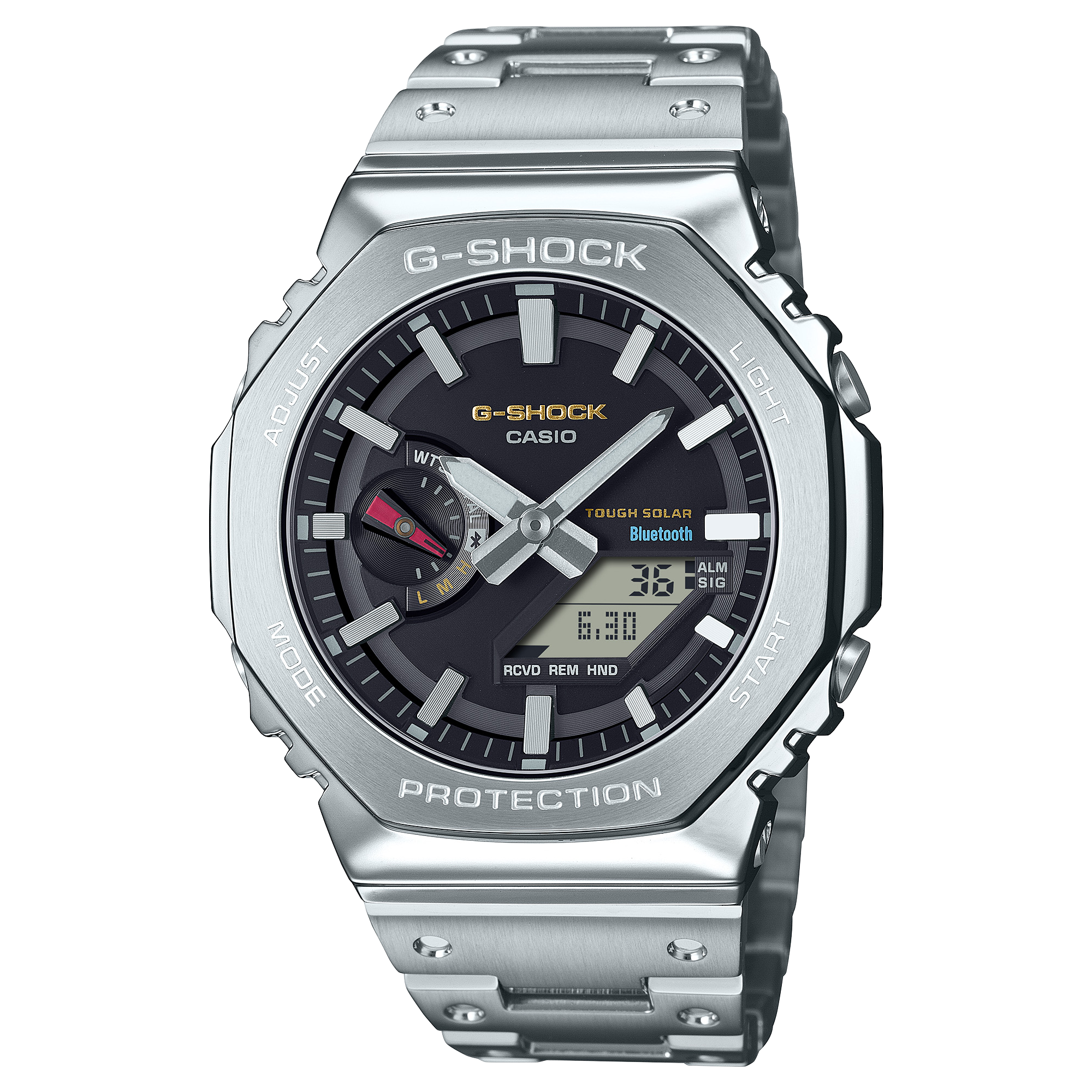
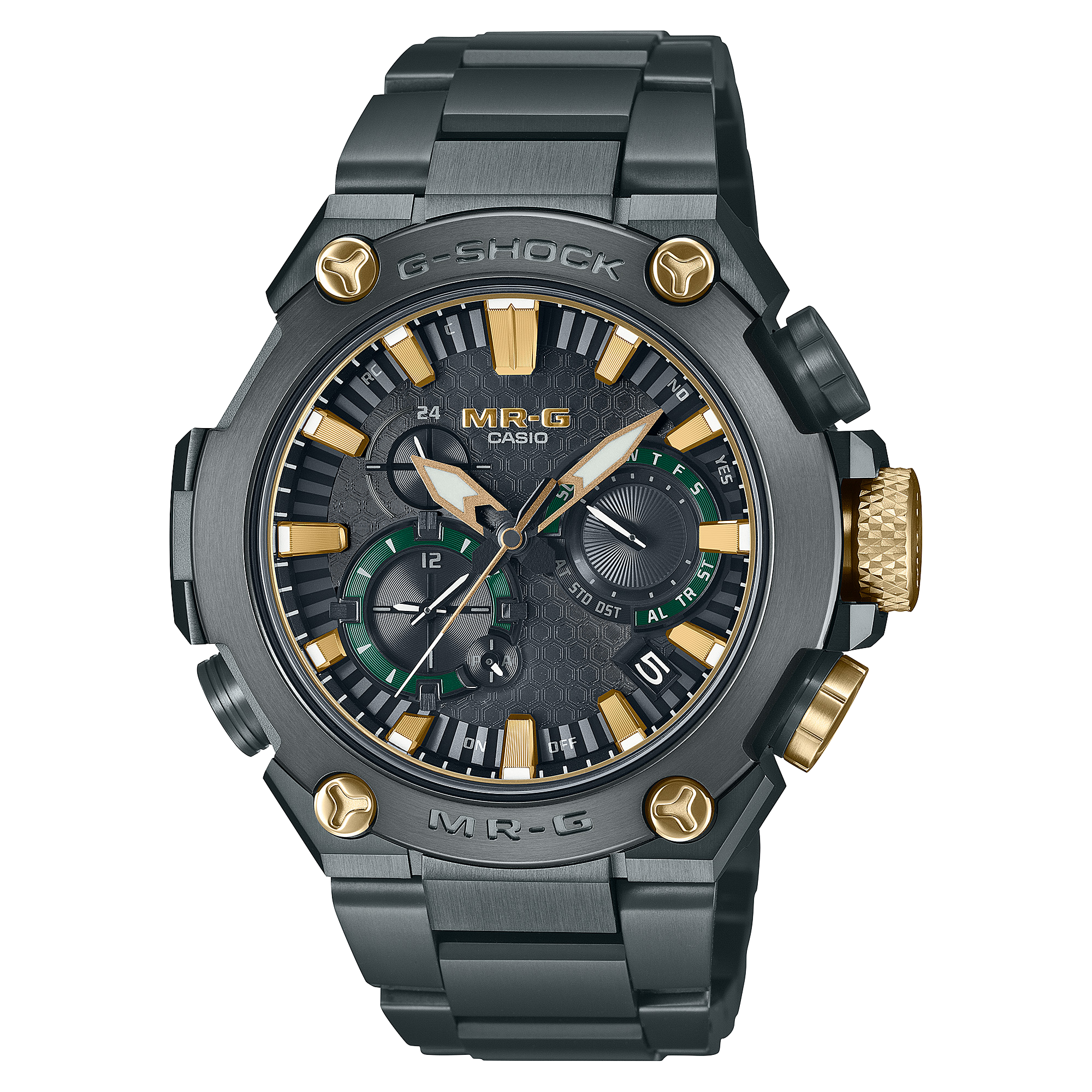
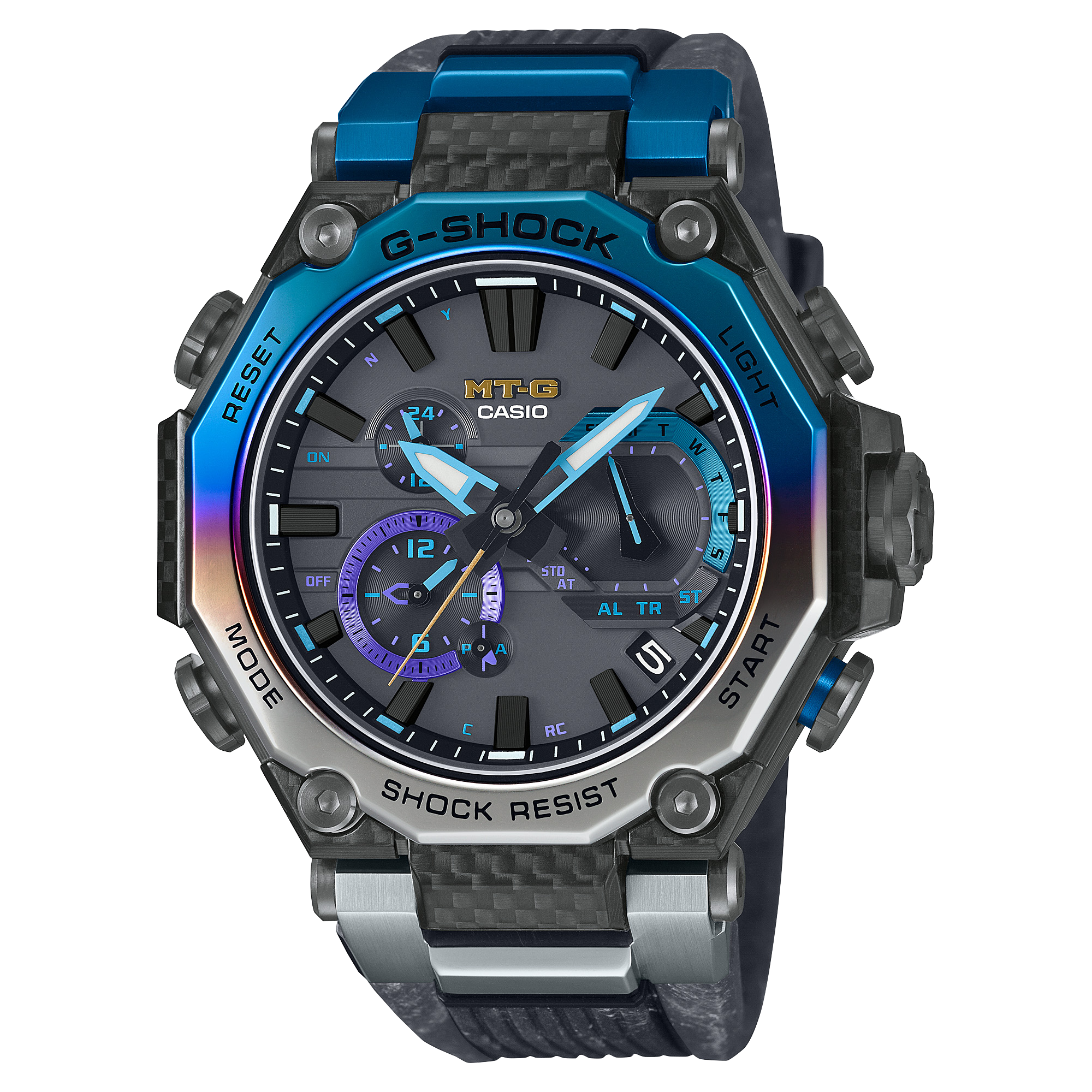
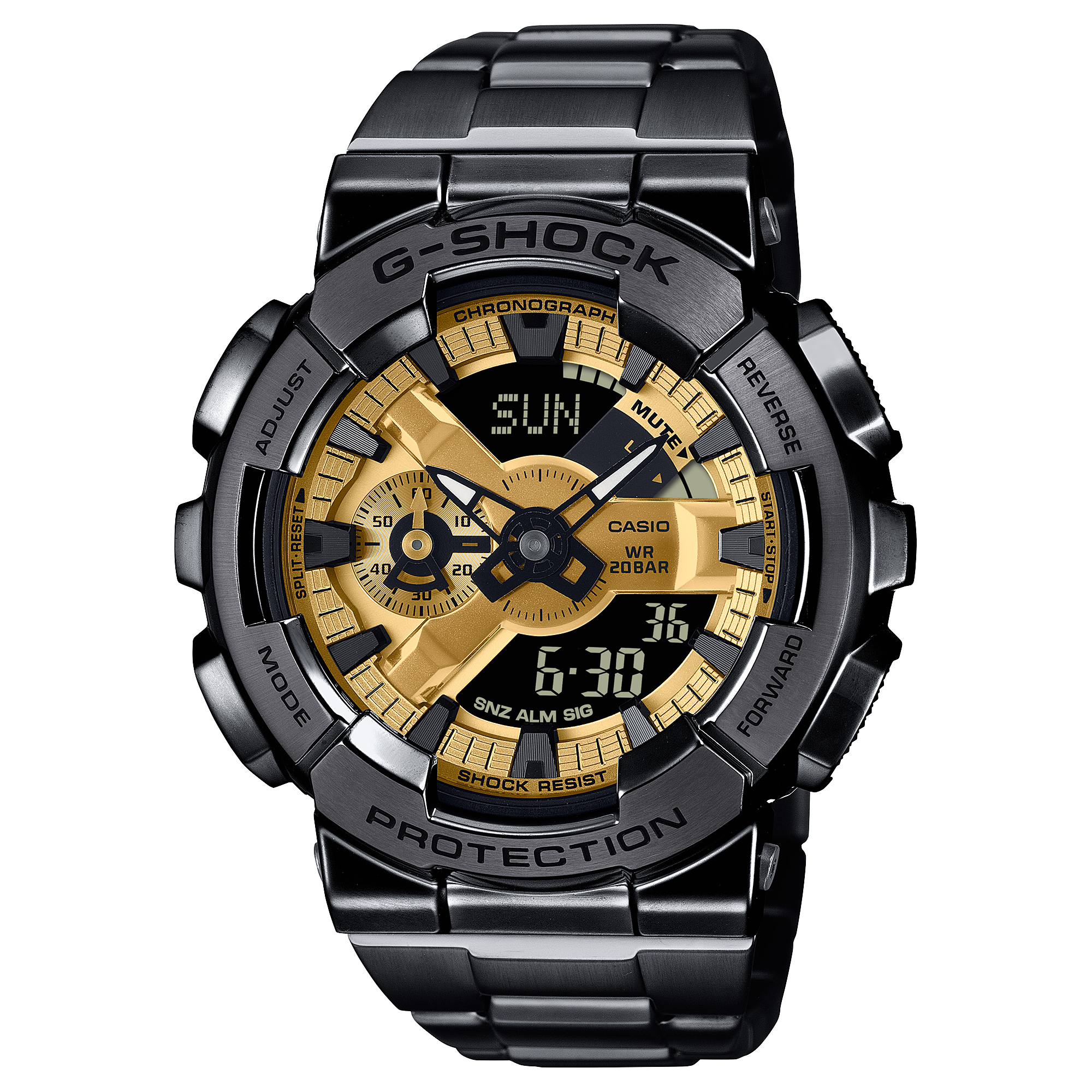


Legend and Legacy – The new MRG-B2100 series adds traditional Japanese inspiration to the MR-G lineup
As featured on Hodinkee

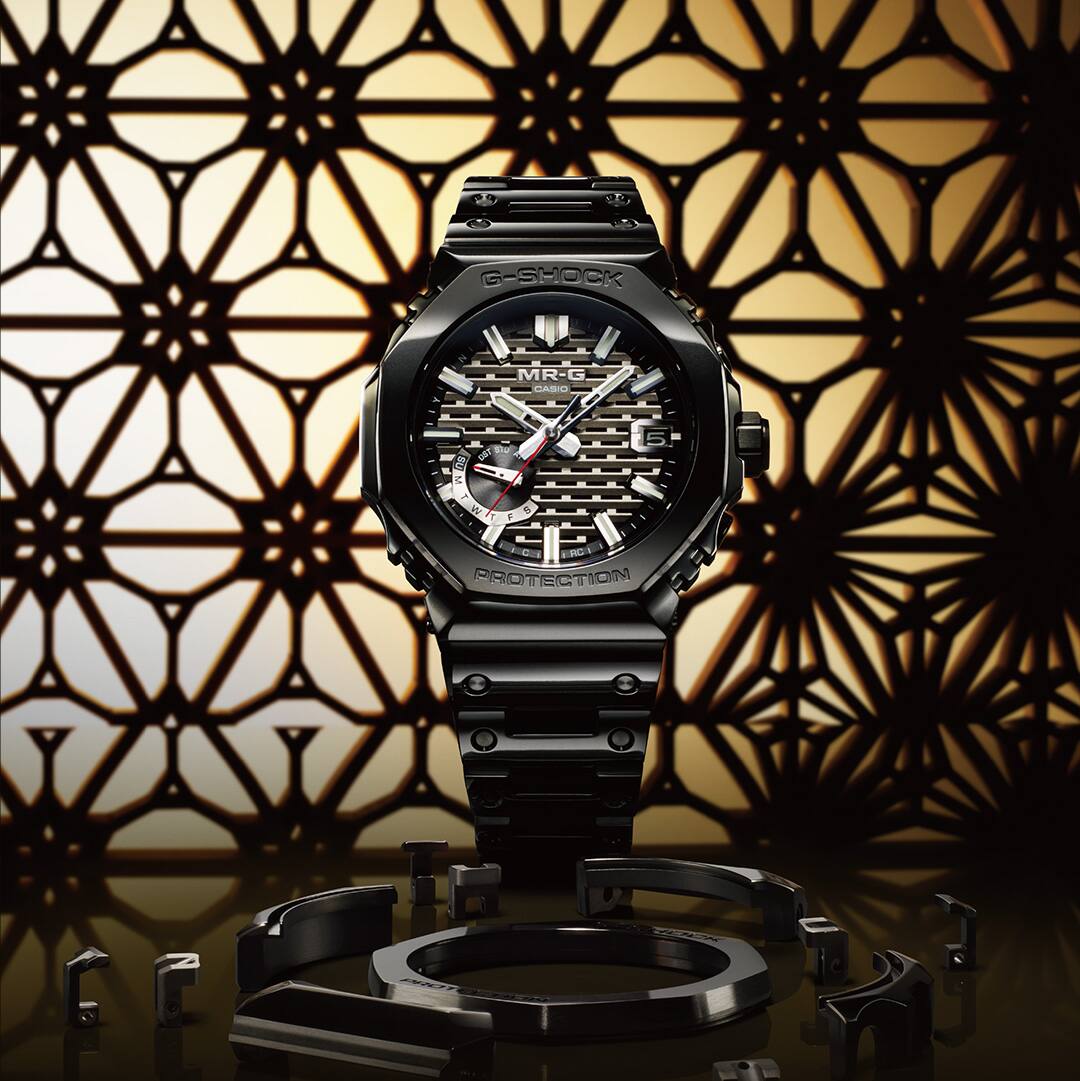
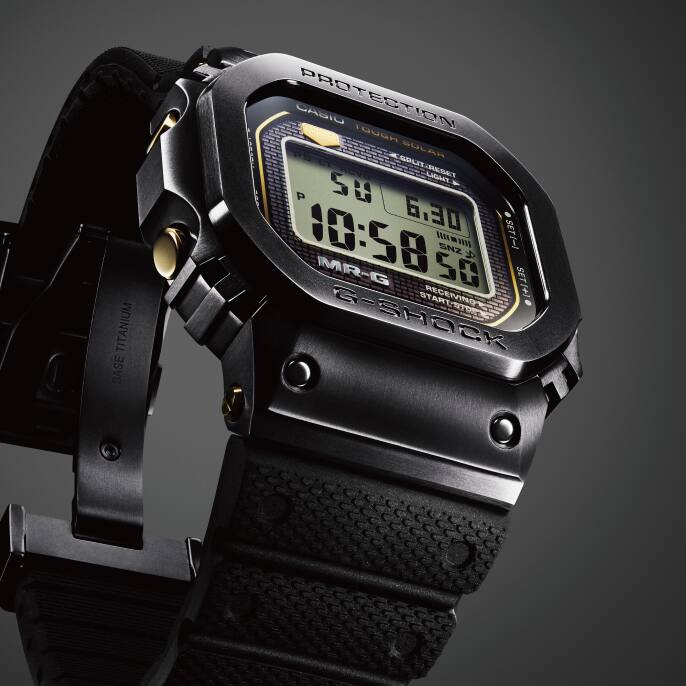
As the pinnacle of the G-SHOCK line, the MR-G family blends the sophistication and substantial feel of metal with the legendary durability and style of the original G-SHOCK. The recently-introduced MRG-B2100 series, which is based on the fan-favorite GA-2100, builds on the legacy further with a polished titanium case and a dial inspired by traditional Japanese kigumi wooden joinery. Following the MRG-B2100’s launch, a third model featuring a rubber strap, the MRG-B2100R, will be added to the collection this season.
MR-G pioneered a new premium price range for CASIO watches when it was introduced in the mid-1990s, and has since earned a loyal following around the globe. To learn more about the evolution of this collection and explore the legacy it offers to future generations, HODINKEE Japan editor-in-chief Yu Sekiguchi spoke to the legendary Mr. Kikuo Ibe, the father of the G-SHOCK and the creator of MR-G. For a more detailed account of the interview, check out the video, which can be played from the top of this article.
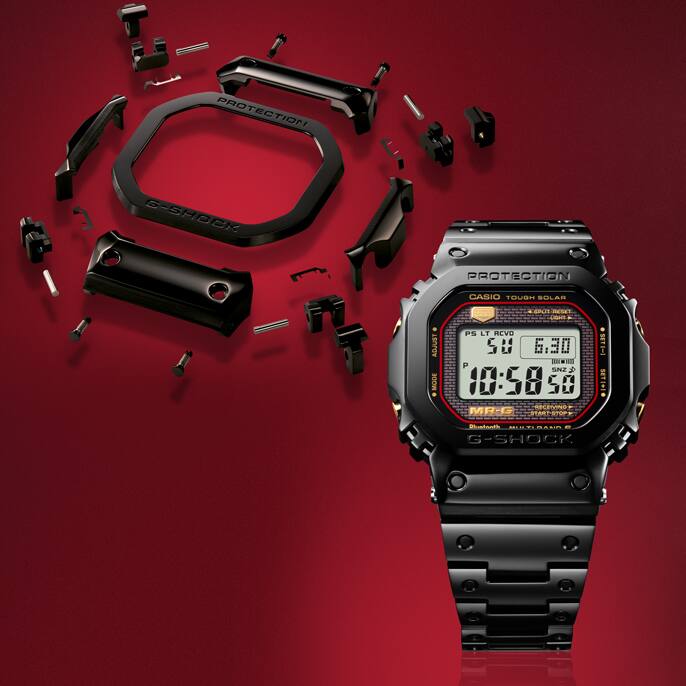
The first MR-G model, the MRG-100, debuted in 1996 as G-SHOCK’s first full-metal design equipped with shock-resistant technology.
(Sekiguchi) “How did the first MR-G come to be?"
(Ibe) “There was a time when G-SHOCK struggled to gain traction among young people. However, one day on the train, I saw a young person holding a G-SHOCK, and I thought, 'Since we've finally gained a younger fan base, why not create a G-SHOCK they can transition to as they grow older?' That idea led to the concept of a full-metal model. When we created the original G-SHOCK, we already knew it was challenging to achieve shock resistance without a resin cover. But I believed that if we gathered the expertise of a few team members, we could overcome that issue. With that thought, I casually initiated the project at the time."
Kikuo Ibe, Father of G-SHOCK
The project to develop G-SHOCK's first full-metal model began in 1994 and it required Ibe’s team to overcome several major obstacles along the way. While the technical challenges were significant, the biggest obstacle was convincing the team that it could actually be done.
(Sekiguchi) “I've heard that the full-metal G-SHOCK project wasn’t officially announced within the company, and it was initially driven by a group of volunteers. Is that correct?”
(Ibe) "I anticipated that the project would be challenging and I didn’t want to put pressure on the team members, so I initially kept it under wraps even within the company, shared only with the top figures in the watch department. This project is the only one that I have never opened up to the public. I had never felt so much difficulty in accomplishing a goal, and I decided I would only disclose it when I could see the completion of the project. As we started the MR-G project many voices said, 'This is not possible', which was expected. I tried to talk them out of it each time, but eventually, I said, 'When it's finished, there will be a magazine interview. Let's be in it together.’ These words were not an optimal solution, but they did help motivate the team members.”
A prototype after undergoing impact testing – including dropping it onto concrete – during the development of the first MR-G.
Mr. Ibe was surprised when, after years of development, the first-generation MR-G garnered strong support from existing G-SHOCK fans as well as those who had never worn a G-SHOCK before.
(Sekiguchi) "The MR-G has evolved into a watch that serves as a canvas for showcasing traditional Japanese craftsmanship. How do you feel about this evolution?"
(Ibe) "At first, I envisioned the MR-G as a tool-like watch that would develop character the more it was used. Over time, it has evolved into something that collaborates with traditional Japanese craftsmanship, much of which is unfamiliar to many people. In this way, MR-G has contributed to Japan’s industry by bringing attention to these traditional techniques. Even though Japan has many remarkable technologies, most people remain unaware of them. When I think about it, MR-G still holds limitless potential, depending on the ideas we bring to it."
(Left) The MRG-100T, a titanium version of the MR-G's first model, the MRG-100 (Right) The square form MRG-110 was released after the MRG-100.
(Sekiguchi) "The MR-G was initially well-received in Japan and has since gained recognition worldwide. Have you observed any shifts in how people perceive the MR-G?"
(Ibe) "At first it was popular mainly in Japan, but as distribution gradually opened up, people began to pay attention. Metal watches have always had a sense of great tradition, like high-end mechanical watches, but MR-G is different from those watches. I think it is a product in a new arena, always evolving and taking on new challenges. Ideally, people would own both a traditional metal watch and a MR-G, switching between them depending on their mood. That would be the perfect scenario."

While the materials and structure of this model follow those of the MRG-B5000, the company also focused on making the case thinner to match the slim form unique to the GA-2100. The one reviewed and adopted here is the Clad-Guard structure, which incorporates α-gel (Alpha-gel) in the crown unit to reduce the impact transmitted from the crown to the watch's interior. CASIO downsized this unit, and the watch was made approximately 3 mm thinner than the MRG-B2000 series, with a similar mechanism. At the same time, this also led to a reduction in the weight of the entire watch.

The MRG-B2100B uses separate parts to represent the dimples on the bracelet, giving it the careful craftsmanship you expect from an MR-G model. In addition, the locking mechanism on the buckle is not gold-colored like the previous MR-G models, but is unified in the same black as the case and bracelet, giving the whole watch a bold look. On the other hand, the case back has been changed to a screw-back instead of screw-fastened case like the B5000, in order to prevent the inside of the case back from interfering with the crown unit. CASIO adopted this structure to reduce the thickness of the case, achieving the precise proportions typical of the 2100 series. The watch exemplifies meticulous attention to detail, enhancing and building upon the strengths of the base model.


The MRG-B2100B is a game-changer. It has a simple display style never seen in previous MR-G models. At the same time, it has a high-quality, elegant, and intrepid look. The case size of 44.4 mm in width and 13.6 mm in thickness may seem significant for a typical 3-hand watch, but it is much more compact than the existing MR-G. Combined with the lightness of the 64-titanium case and the DAT55 bracelet, it feels great to wear despite its heavy appearance.

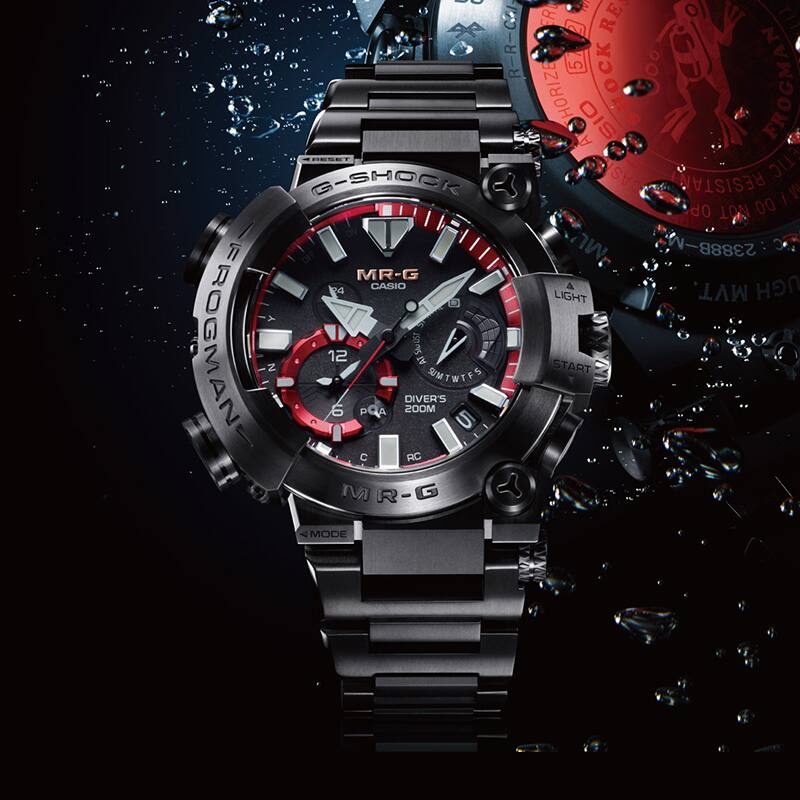
MR-G is not just a watch that applies traditional Japanese techniques or incorporates advanced materials from Japan. It is a collection full of craftsmanship that maximizes the appeal of designs and materials while making full use of advanced manufacturing techniques that have been cultivated for many years at production facilities centered around Yamagata CASIO. The MRG-B2100B, a new addition to the collection, is a formidable watch that combines creativity with a simple three-hand design and slim proportions, both of which CASIO has long sought with G-SHOCK. There are not many examples of G-SHOCK making such a design simplification, and the development team was worried about taking on the challenge when the project was launched. However, the lineup was greatly expanded by introducing designs that set it apart from existing models, such as the MRG-B5000, which follows the original design, and the MR-G FROGMAN, which emphasizes a tool-like appearance. The MRG-B2100B represents a new wave for the MR-G line, appealing to new fans while also offering fresh value to existing enthusiasts.

All content including images is credited to Hodinkee.